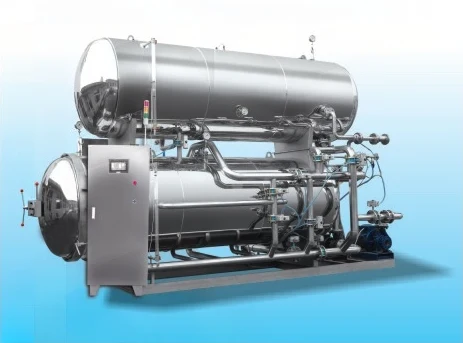
Water-immersion double-layer retort
Water immersion and a separate hot-water vessel can be evaluated when the confirmed process, package, load pattern and heat-transfer requirements support this arrangement.
PACKAGED FOOD THERMAL PROCESSING
Select a water-immersion double-layer, water-spray or steam retort around the packaged product, validated thermal process, batch load, pressure control, cooling route and factory utilities.
PROCESS BEFORE MACHINES
Retort selection changes with the food, container material and geometry, fill conditions, heat-transfer behaviour, required thermal process, pressure management, batch load, cooling method and available utilities.
That is why this page explains the selection logic without publishing unconfirmed capacity, energy or price figures.
FROM THE ANBANG PRODUCT CATALOG
Use this catalog equipment image alongside the process options below. The final vessel arrangement, heating method and controls follow your confirmed project.
PACKAGED FOOD / BATCH PROCESSING
The Anbang catalog shows a double-layer vessel arrangement for packaged-food thermal processing. Review the water-immersion option against your product, container and established process.
Before quotationFor a quotation, send container dimensions, basket loading, required batch output, validated processing cycle and available steam, water and compressed air.
Discuss this configurationTYPICAL PROCESS FLOW
The exact route is confirmed after the product and plant brief. Optional steps may be added, removed or adjusted.
CONFIGURATION LOGIC
Each module should support the steps before and after it. Selection is based on your confirmed product route rather than a generic machine list.
Water immersion and a separate hot-water vessel can be evaluated when the confirmed process, package, load pattern and heat-transfer requirements support this arrangement.
Circulated heated water and the spray arrangement are selected around container coverage, indirect heating and cooling, counter-pressure needs and the established process.
Direct steam processing can be evaluated for compatible products and containers. Venting, come-up and operating procedures must match the validated scheduled process.
Baskets, loading, door arrangement, safety interlocks, temperature and pressure records, cooling and utility interfaces are confirmed as one system.
FOOD, PACKAGE & LOAD
Prepare one brief for each product and package combination. A pouch, jar or tray name alone is not enough to select a food sterilization retort.
Describe the formulation category, liquid and solid components, piece size, fill weight and condition before processing. Supply the established process and its critical factors, or state that process development is still required.
Send the container drawing, material, closure or seal specification and packaging supplier guidance for retort use. Include filled dimensions and required supports. Confirm compatibility before ordering baskets or committing to a machine.
Specify packs per layer, orientation, separators, basket handling and the proposed batch mix. Loading is part of the process review; changing the arrangement is not simply a way to fit more packs into a vessel.
BATCH OUTPUT & UTILITIES
State the required finished packs per shift and the productive hours available. Capacity remains project-specific until the package, load and process are agreed.
Review the actual container dimensions and basket layout. In a double-layer water-immersion arrangement, distinguish the water-storage vessel from the product chamber. Neither total vessel volume nor an illustration is a rated food load.
Account for loading, come-up, scheduled processing, cooling and unloading when planning batches. Include cleaning and product changes in the shift plan. Do not shorten an established process to meet a desired output.
Confirm electricity, steam, water, compressed air, drainage and cooling supply. Where several units share services, review simultaneous demand. Request project-specific peak requirements and interface responsibilities in the quotation.
QUOTE & VALIDATION BOUNDARY
No universal temperature, holding time or shelf-life promise belongs in a generic retort quotation.
Ask which baskets, handling devices, circulation components, heat exchangers and utility connections are included. Define controls, recorded variables, record export, instrument calibration, safety interlocks and training requirements for review; these are confirmation items, not claims that every model includes them.
A qualified processing authority should establish or review the scheduled process for the actual product, package and installation. Heat distribution and product heat penetration are different validation questions. Agree responsibilities and required evidence before production.
For an upstream pouch or tray line, use the food packaging machine selection guide to prepare the packing brief, then separately confirm that the finished package is suitable for the intended retort process.
BEFORE MACHINE SELECTION
Share what you already know. If any field is not decided, Anbang can list the options that need confirmation.
CAPACITY & PRICE
Capacity and price cannot be determined accurately from vessel size alone. Final configuration depends on the package and loading pattern, validated cycle, required batch throughput, retort method, vessel and door arrangement, heat exchanger, compressed-air system, controls and records, utilities, handling scope and delivery requirements.
Anbang provides a project-specific recommendation after these inputs are reviewed.
BUYER QUESTIONS
Start with the product, retort-compatible package and validated process. Review heating-medium contact, circulation or venting, pressure control, basket loading and cooling. There is no universally best method based only on the food name or vessel size.
No. The Anbang catalog shows a separate upper water vessel and lower processing vessel. Do not count the water vessel as a second product chamber. Request the usable product load and complete cycle basis for the quoted configuration.
These formats require individual evaluation. Obtain the packaging supplier specifications for retort use, dimensions, closure and pressure or temperature limits, then review them with the food and loading arrangement. Ordinary vacuum packaging is not automatically retort-compatible.
Compare usable packs per load and complete cycles per productive shift for the same product and package. Include loading, come-up, scheduled processing, cooling and unloading. Vessel volume or basket count alone does not establish saleable output.
Do not assume it can. Changes in product, package, fill conditions or loading can affect the process. Ask a qualified processing authority to assess the actual combination before using or changing a scheduled process.
Ask for an itemized scope covering the vessel arrangement, baskets, loading equipment, heating and cooling interfaces, circulation, controls and records, installation and commissioning. Compare offers only after agreeing the process and output basis.
Provide the available supply conditions and cooling-water conditions at your factory. Required loads and operating conditions follow the selected machine and process. Ask for a utility schedule, including peak requirements, rather than assuming generic consumption figures.
No. Equipment purchase does not validate the food process, package integrity, storage conditions or shelf life. Confirm the validation work and destination-market requirements with qualified specialists; this page is an equipment-selection guide, not a sterilization recipe.
START WITH YOUR PROCESS
The prepared message asks for the details needed to discuss a practical configuration and quotation.